
INPUT
Source systems
Metering, billing and rate records.
Governed reconciliation for systems that disagree
Can software reconcile conflicting records across systems while keeping automated decisions bounded, auditable and subject to policy?
THE PROBLEM
SaaS revenue reconciliation is the first use case, not the whole problem. Any business with several systems describing the same activity eventually has to decide which record is right and what to do when they disagree. The same pattern appears in orders and fulfilment, supplier invoices and goods received, and payments and settlement.
Today that work often falls to experienced analysts. They pull exports, map identities, rebuild the comparison, investigate exceptions, make a correction and then chase confirmation that it landed. The expensive part is not finding a difference. It is the hours of skilled work needed to establish what happened and repair it safely.
When that work is delayed, the cost compounds. An incorrect charge can become a refund, a support case and a trust problem. A missed charge becomes lost revenue. In either direction, the explanation is often buried in a spreadsheet or Slack thread, making the next investigation take just as long.
WHAT I DID ABOUT IT
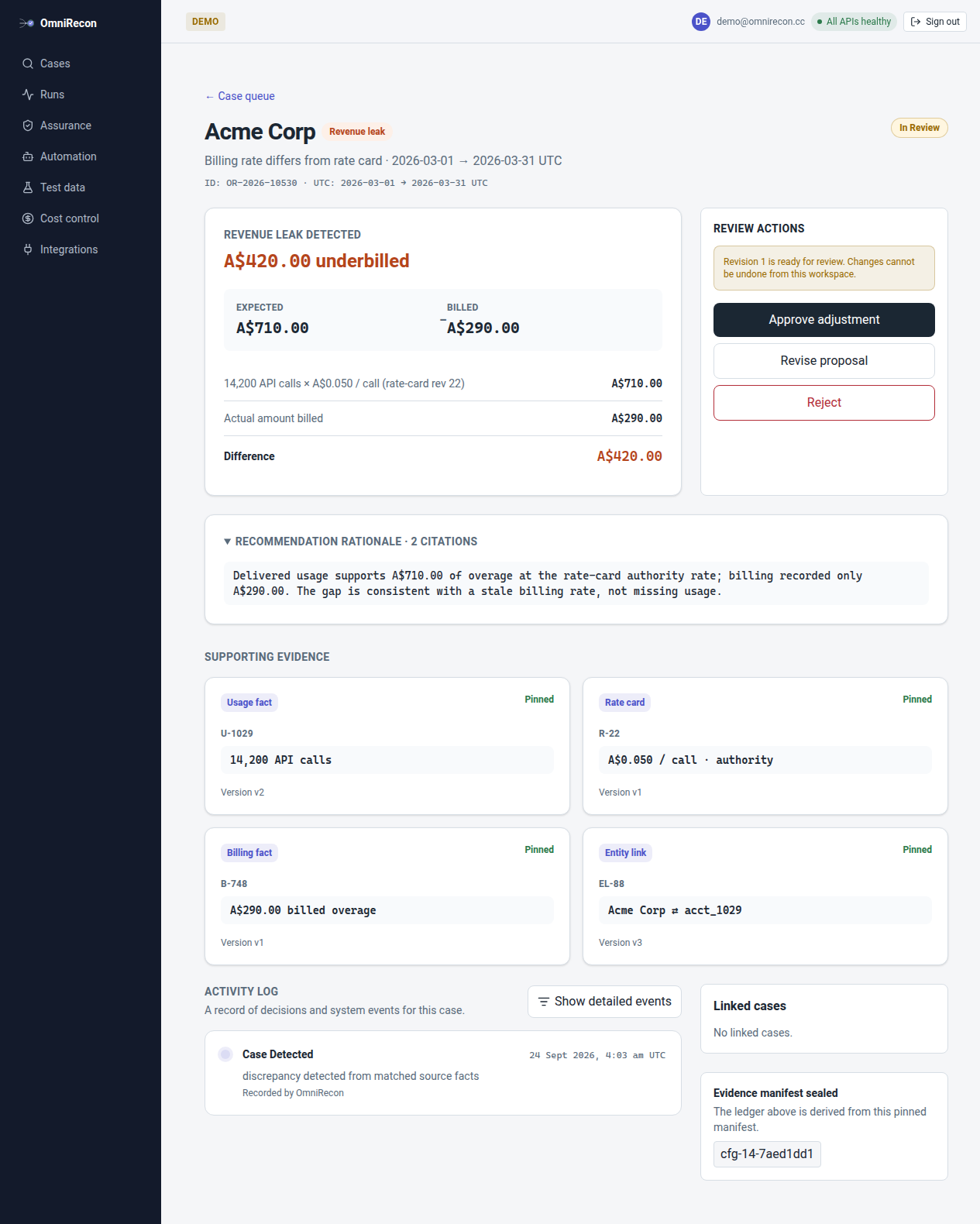
A reconciliation platform that compares source records automatically, settles straightforward matches and creates a review case only where systems still disagree.
In the implemented prototype, the agent helps triage unresolved cases. Investigation and corrective proposals are designed boundaries, not completed autonomous workflows. A separate policy engine decides whether any future action could be automatic, needs human approval or is denied.
A correction is checked on the next ingestion pass rather than assumed to have worked. The case and event log keep the evidence, decision and outcome together.
TRY IT YOURSELF
The application runs separately. It opens in a new tab.
Open OmniRecon demoBEFORE AND AFTER
Exports and mapping tabsProvenance-stamped facts
Spreadsheet lookupsDeterministic correspondence rules
Flagged rowsCases with evidence and policy state
Usually uncheckedSelf-reconciliation on next ingestion
ARCHITECTURE
RECONCILIATION FLOW
INPUT
Metering, billing and rate records.
BOUNDARY
Gated reads and writes.
STORE
Immutable provenance.
RULES
Rules and tolerances.
RESIDUE
Investigate unresolved residue.
GOVERNANCE
Authorise, then verify.
The split is deliberate: models help with ambiguity, while matching, authorisation and arithmetic remain outside the model. The engineering notes include five interactive diagrams of the implemented lifecycle.
BUSINESS IMPACT
The approach could return skilled analyst time to exceptions that genuinely need judgement, instead of repeatedly assembling evidence and checking straightforward records by hand.
Resolving and verifying a discrepancy before it reaches customers or the close process could reduce the cost of refunds, support work, write-offs and repeated investigation.
Observed means measured in a real engagement. Estimated is reasoned from the work but not measured. Potential is what the approach makes possible. Nothing here is dressed up as more than it is.
CODE
The source code remains private while OmniRecon is in progress. Request access to the reviewed architecture and decision records.
Request architecture accessSHARE AND ENJOY
Tell me what's going on. I'll come back within a business day, and if I'm not the right person for it I'll say so.